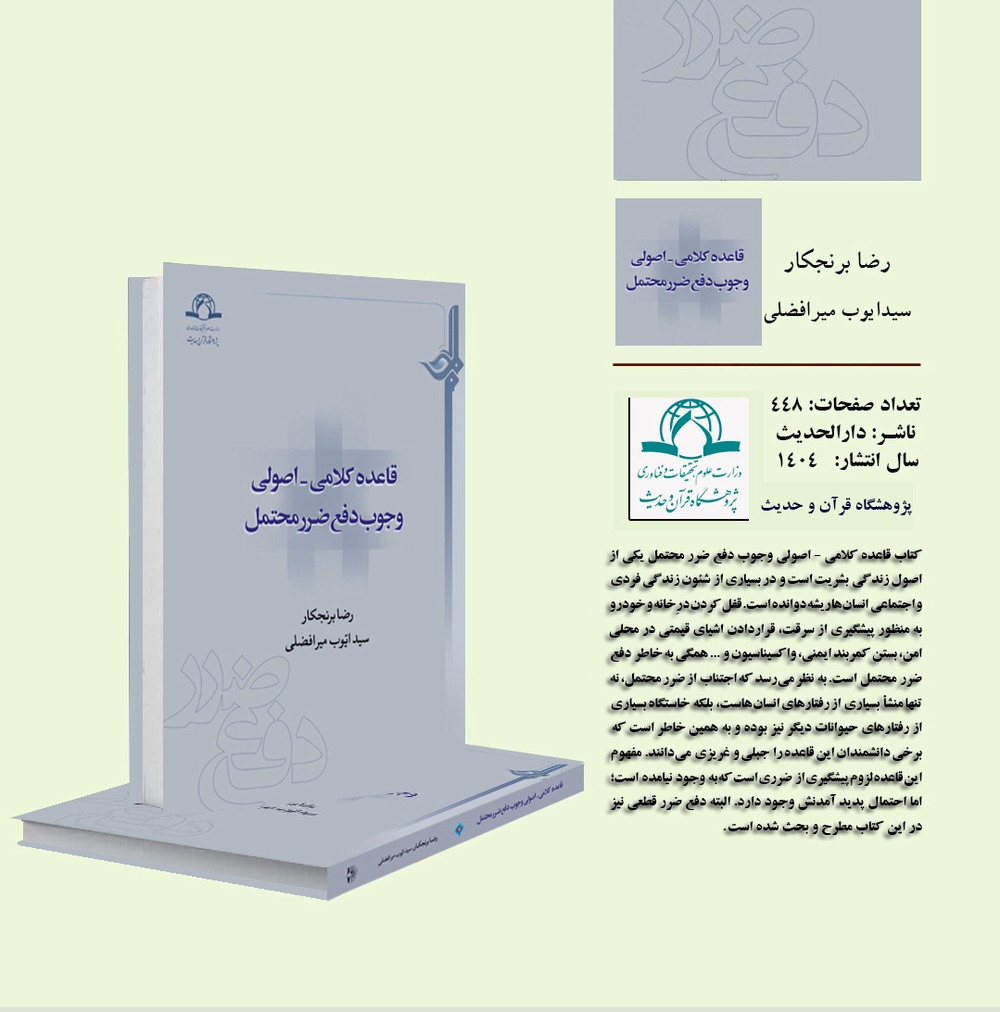

Publication of the Book The Theological-Legal Theoretical Rule of the Necessity of Averting Potential Harm
The book " The Theological-Legal Theoretical Rule of the Necessity of Averting Potential Harm" (Qa'idah-ye Kalami-Usuli-ye Wujub-e Daf'-e Zarar-e Mohtamal), authored by Hojjat al-Islam wal-Muslimin Dr. Reza Berenjkar and Hojjat al-Islam Seyed Ayoub Mirafzali, has been released by the Research Institute of Quran and Hadith.
According to the Public Relations Department of the Research Institute of Quran and Hadith, the theological-jurisprudential rule of "the necessity of warding off probable harm" constitutes one of the foundational tenets of human life, deeply embedded in numerous facets of individual and social conduct.
Locking the doors of houses and vehicles to prevent theft, keeping valuables in secure places, fastening seatbelts, and receiving vaccinations are all pragmatic measures driven by the imperative to avert probable harm.
Avoiding potential injury or loss is not only the origin of many human actions, but it also governs the survival behaviors of animals; hence, some scholars consider this principle innate and instinctual.
The essence of this principle lies in the necessity of preempting a harm that has not yet materialized, but whose occurrence is anticipated. The book also covers the averting of certain (qat'i) harm.
What this book explores is a principle governing human conduct, which also bears direct relevance to man's existential relationship with God: namely, "the obligation to avert probable harm." Under this principle, specific duties become incumbent upon human beings, and it serves as the major premise (kubra) in rational syllogisms deployed to deduce obligations and responsibilities.
This principle is extensively examined and applied across scholastic theology (Kalam), ethics (Akhlaq), jurisprudence (Fiqh), and legal theory (Usul al-Fiqh). It holds a particularly pivotal station in Kalam: many theologians, at the very inception of theological inquiry—specifically in establishing the duty of rational inquiry (wujub al-nazar)—invoke the rule of averting harm, utilizing it subsequently to substantiate the existence of God.
It is worth noting that this work is the culmination of the advanced seminar lectures (Dars-e Kharij) in Kalam delivered by Hojjat al-Islam wal-Muslimin Dr. Reza Berenjkar during 2023–2025 (1402–1403 SH) at the Seminary Islamic Theology Association.
Structured along these analytical lines, the book comprises seven chapters along with a critical appendix on the arguments of consensus (ijma'):
- Chapter 1: Significance, Historical Background, and Conceptual Framework
- Chapter 2: Evidentiary Grounds of the Principle
- Chapter 3: Nature of the Rational Judgement
- Chapter 4: Scope and Typology of Harm
- Chapter 5: Degree of Probability
- Chapter 6: Applicability of the Principle to Harm Affecting Others
- Chapter 7: Implications and Outcomes of the Principle
- Appendix: Critical Examination of the Arguments from Consensus (Ijma')
Authored in Persian by Hojjat al-Islam wal-Muslimin Dr. Reza Berenjkar and Hojjat al-Islam Seyed Ayoub Mirafzali,"The Theological-Legal Theoretical Rule of the Necessity of Averting Potential Harm"is published in Royal Octavo format across 448 pages, and was released in 2025–2026 (1404 SH) in collaboration with Dar al-Hadith Publications.
To receive news and programs from the Research Institute of the Quran and Hadith via the Eitaa messenger:
https://eitaa.com/quran_hadith
Original Source of the News